Skiddle Promoter Marketing
Selling more Skiddle tickets with paid social and search starts before the first advert. It starts with the event’s tracking setup. If a completed order is not reported accurately, the ad platform cannot learn from real buyers. A campaign may still generate clicks and page views, but those are not the commercial outcome. The outcome is a ticket sold, at a cost the promoter can defend.
Skiddle says it works with more than 35,000 UK and European promoters. Its Promotion Centre is used across live music, clubbing, festivals, theatre, comedy and arts. Those categories do not share one buying pattern. A local gig can move heavily in show week. A club night may wait until the final 48 hours. A festival has announcement waves and tiers. We use the platform setup as the measurement foundation, then plan spend around the event’s actual curve.
What Skiddle tracking supports.
Skiddle documents the following tracking options in its Promotion Centre. Availability and account configuration still need checking before launch; we do not treat a menu option as proof that an event is reporting correctly.
Event-level setup
Pixels are added per event in the Skiddle Promotion Centre under Promotion → Tracking. This makes event setup a deliberate pre-on-sale task rather than something to revisit after spend begins.
Advertising and analytics pixels
Skiddle supports Google Ads, Google Analytics, Meta (Facebook), Snapchat and TikTok pixels. Use only the services you actively operate and can test.
Meta browser events
Skiddle fires AddToCart and Purchase events to Meta. ViewContent is available on request, so check with Skiddle if that event is useful to the agreed measurement plan.
Meta Conversions API
Skiddle also sends Purchase events to Meta server-side alongside the browser pixel. It uses a unique order ID so Meta can de-duplicate the two signals rather than count one order twice.
Access token requirement
The server-side connection uses a Conversions API access token generated for the same Meta pixel. A token for a different pixel breaks the intended browser-and-server pairing.
Promoter category
When an organiser joins the Promotion Centre, Skiddle asks for a main event type, including Live music, Clubbing, Festival and Theatre/Comedy & Arts. That category is useful context, but the promoter’s own export still decides the curve.
Just opened a Promotion Centre account? Do this first.
Choose one Meta pixel per brand.
Do not share one pixel across unrelated brands simply because it is already available.
Add it to the event.
In the Promotion Centre, open Promotion → Tracking and enter the chosen pixel. Check with Skiddle if the interface or access differs.
Generate the matching access token.
Create a Conversions API access token for that same pixel in Meta Events Manager, then add it through the Skiddle process.
Ask about ViewContent.
Skiddle provides ViewContent on request. Check with Skiddle whether enabling it serves your measurement plan.
Add only the other services you use.
Connect Google Ads, Google Analytics, TikTok or Snapchat when they are part of the active campaign.
Test a completed purchase.
Check the order in Events Manager and confirm browser and server Purchase are de-duplicated rather than counted twice.
Build audiences from day one.
Start with clean ownership and useful event engagement so the first on-sale adds to the right brand history.
Optimise for Purchase.
Once the test is reliable, make the completed ticket order the campaign objective rather than clicks or landing-page views.
Or send us your event link and we’ll check it for you.
Book the tracking audit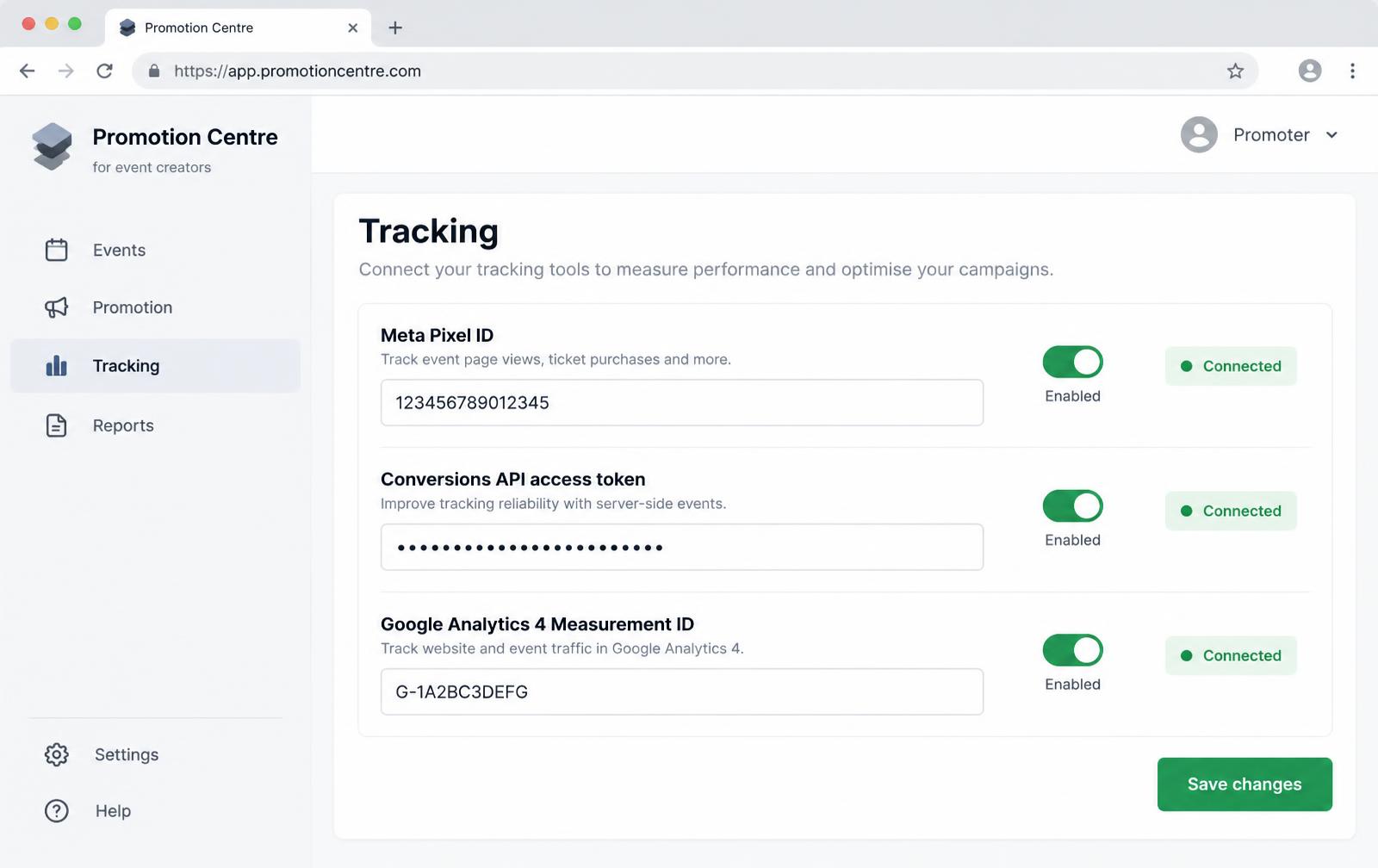
Common set-up mistakes we fix.
One pixel shared across unrelated brands
A festival, a club series and a venue programme should not be pushed into one indiscriminate learning pool. We check ownership and choose one appropriate Meta pixel per brand rather than inheriting whatever ID was copied into the last event.
The event has a pixel but no valid token
Browser tracking alone and browser plus Conversions API are different setups. We check whether the access token exists, belongs to the same pixel and is still accepted before calling server-side Purchase live.
Purchase fires, but the order is counted twice
Browser and server Purchase events need the same unique order reference for de-duplication. We compare test activity with the real order and inspect whether Meta is merging rather than multiplying the signals.
The wrong event is treated as the sale
AddToCart is useful context, but it is not revenue. We make the completed Purchase the optimisation target when the tested setup can report it reliably.
Campaigns optimise for easy clicks
Traffic and landing-page-view objectives can make reporting look cheap while the box office stays quiet. Once Purchase is working, the buying event should guide optimisation.
Tracking is copied after the on-sale
Late setup loses the clean beginning of the buying curve. We want the event configured and tested before the first public push, so announcement buyers and final-week buyers sit in one coherent measurement window.
How we run Skiddle campaigns.
Audit the Promotion Centre setup.
We review the event under Promotion → Tracking, the chosen pixel, the matching Conversions API token and any Google, TikTok, Snapchat or analytics IDs in active use. Then we test the purchase path instead of assuming saved fields equal working measurement.
Curve the relevant Skiddle exports.
Previous event exports show when this crowd bought. We compare similar dates, prices, genres and rooms, then mark tiers, lineup drops and final release. Zombie Fest 9 used previous-year curve analysis alongside its Skiddle Conversions API integration.
Phase spend around the buying window.
Announcement activity gets a defined budget, not the entire allowance. We reserve meaningful spend for the final week and the final 72 hours, then adjust against real sales pace and remaining ticket stock.
Push the available ticket and prove the cost.
Late creative names the event, place, date and genuine release. After the event, we reconcile campaign reporting with ticketing sales and explain cost per ticket, de-duplication and any measurement limits.
Skiddle campaigns need the event, the audience and the clock to agree.
A Skiddle event page can be the conversion destination, but the advert still has to do the selling work. For a gig, that may mean a strong live clip, the full bill, venue and current price. For a club night, lineup-led short-form creative and an accurate “final release” can support the short decision window. For a festival, each lineup wave should connect to the ticket product people can actually buy. We do not run the same creative sequence merely because all three events use Skiddle.
Audience structure follows the promoter, not a generic template. Local prospects, previous buyers and engaged viewers have different levels of intent. The clean pixel and Purchase signal let Meta learn from actual orders, while the promoter’s own sales export keeps the report grounded. We do not claim every order after an impression came from paid media, and we do not confuse an AddToCart with a completed booking.
Zombie Fest 9 at Cambridge Junction used a Skiddle Conversions API integration as part of a full tracking repair and sales-curve project. The 1,500-capacity event takes place in October 2026, with results landing in November 2026. Until then, it is proof of the method and setup only. Client permission is required before sales data is published.
Skiddle’s event-type choices point to the practical difference between campaigns. Promoters running gigs can read our gig promotion approach. Electronic promoters can see why club nights need a stronger final-48-hour plan. Festival teams can see how tiers and lineup announcements change phasing. The platform connection is the foundation; the event’s buying behaviour is the strategy.
Different events. Different curves.
Skiddle: four practical questions.
Check the setup.
Then find the curve.
Send the event details first. Add Skiddle in the optional second step — it is already selected for you.
No platform partnership implied. Just an independent check.